
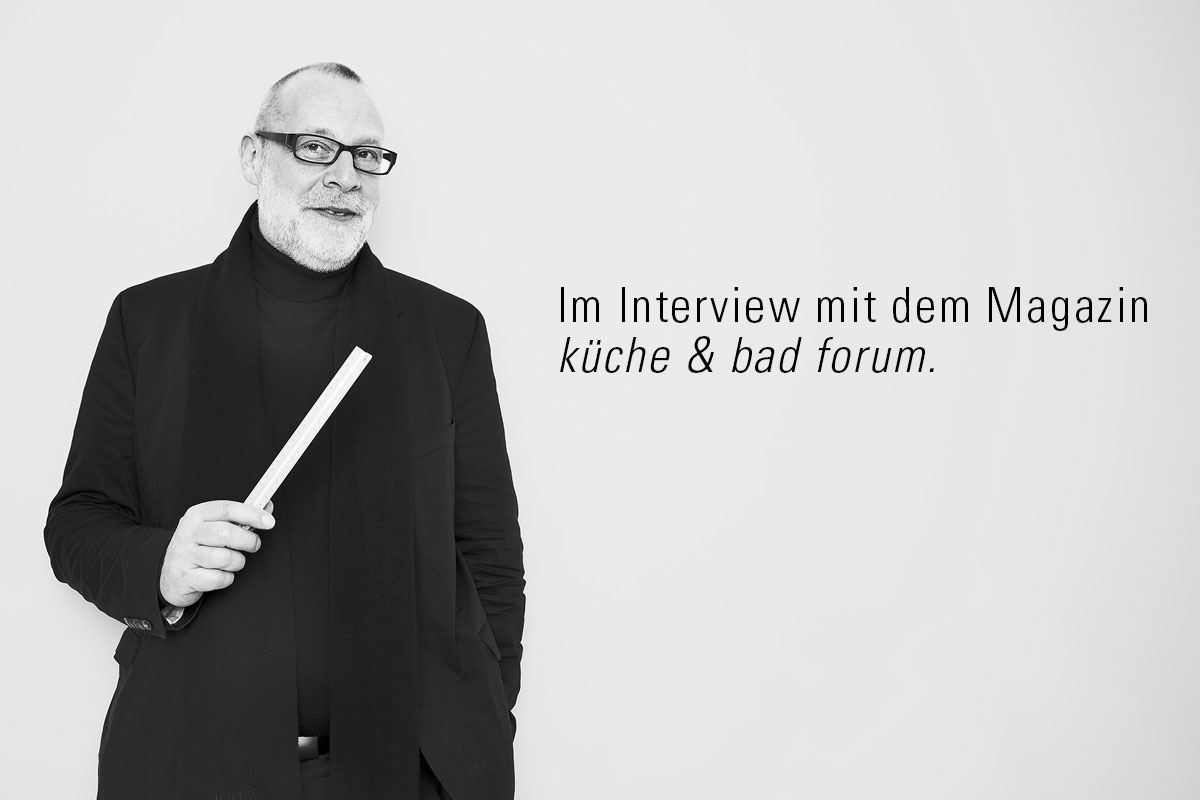
Rainer Kalesse interviewed by the trade magazine »küche & bad forum«, May 2017
As chief designer, Rainer Kalesse shaped the face of Nolte Küchen for over 25 years. At the beginning of March he set up his own design management office in Lemgo. His clients include well-known companies in the furniture and kitchen industry. In the interview, the 55-year-old explains his view of kitchen design and talks about visual lightness, multifunctionality and greater adaptability.
What matters in good design?Rainer Kalesse: The essential thing is to pursue an idea with consistency and to carry one uniform line through the design. In the end, everything should be in harmony. That is why a certain consistency is always the linchpin.
What defines the modern, contemporary kitchen for you?Rainer Kalesse: In general, the kitchen is going through a fairly major period of upheaval right now. In the past, everything was made increasingly large-scale, cubic and angular. As a result, the space – which, by the way, still averages only 8 to 12 square meters – became more and more distant in form. But that distance is now dissolving again. You can see it in the fact that more shape and also changes of material are finding their way into the kitchen. It is also becoming much more multifunctional. That means the furniture can do more and more, is more adaptable and can ultimately meet more demands. At the same time, the modern, contemporary kitchen is characterized by its visual lightness. Slim profiles are popular.
What do you base that on?Rainer Kalesse: The slimmer dimensions are nice to see in countertops, for example. Solid-core countertops or the material Swiss CDF are often used today. They reflect the delicacy and enrich modern kitchen design. The countertop is a huge instrument for making the kitchen's other profiles appear in a completely different way.
What effect does this have on the currently popular living kitchen?Rainer Kalesse: The kitchen is opening up significantly – and not only toward the living space. The shelf takes on a completely different importance. It is used more and more in the kitchen and so creates a connection. By using other materials, there are also possibilities to create interesting, slim looks in the kitchen – away from the closed surfaces that radiate a certain anonymity. Everything becomes much more lively.
What is more important in the living kitchen – functionality or design?Rainer Kalesse: Both have to be in absolute harmony. There are no priorities, because one builds on the other. Functionality in the sense of adaptability is becoming ever more important, however. In the fittings sector, for example, quite a lot is happening to make entirely different functions possible in the first place.
Which trends that are already foreseeable today will shape kitchen design in the coming years?Rainer Kalesse: Besides the points already mentioned, it will become even homelier and more authentic. Creating an individual feel-good atmosphere is becoming more and more important.
What role will smart features play?Rainer Kalesse: Digitalization will of course change the kitchen too – including its design. However, the topic should not be overrated. Let me give an example from the fittings sector: electronic opening of drawers has not really caught on. That was too much high tech. Push-to-open solutions, on the other hand, are very popular. If the kitchen buyer is to spend more money, it has to be real added value. The same can be said of digitalization.
Mr. Kalesse, thank you for this conversation.